Understanding Rochester's Foursquare Architecture and Insulation Challenges
Rochester's distinctive foursquare homes, built primarily between 1900 and 1930, represent a significant portion of the region's residential architecture. These sturdy, practical homes feature a boxy two-story design with a full attic and basement, making them both charming and challenging to insulate properly. The construction methods of that era, combined with decades of settling and wear, create unique obstacles for modern energy efficiency upgrades.
One of the most vexing issues homeowners face with foursquares is balloon framing, a construction technique where wall studs run continuously from the foundation to the roof line without fire stops between floors. This design, while economical for builders in the early 1900s, creates vertical cavities that allow air to move freely throughout the walls and into the attic. In a Rochester foursquare, this means heat loss in winter and heat gain in summer are amplified, driving up utility bills and creating uncomfortable temperature variations from room to room. Additionally, these continuous cavities can harbor pests and moisture problems that are difficult to detect and remedy with traditional insulation methods.
The Balloon Framing Problem and Why Traditional Insulation Fails
Balloon framing creates a thermal and air-sealing nightmare for homeowners trying to improve energy efficiency. Unlike modern platform framing, where each floor acts as a separate structural unit, balloon framing allows conditioned air to escape vertically through wall cavities, completely bypassing the intended insulation layer. Blown-in cellulose or fiberglass cannot adequately seal these continuous voids because the material settles over time, creating gaps and leaving the cavity partially empty. This is why many Rochester homeowners with older foursquares report that traditional insulation upgrades deliver disappointing results.
The solution lies in Wall & Injection Foam Insulation, which fills cavities completely and adheres to all surfaces, creating an airtight seal that traditional materials cannot match. Injection foam expands to fill voids and settles minimally, providing long-term performance that blown-in alternatives simply cannot deliver. For foursquares with balloon framing, this approach addresses not only insulation but also air sealing, which is critical for controlling energy loss and preventing pest infiltration.
Tackling Third-Floor Attics: Why Spray Foam Works Better Than Old Insulation
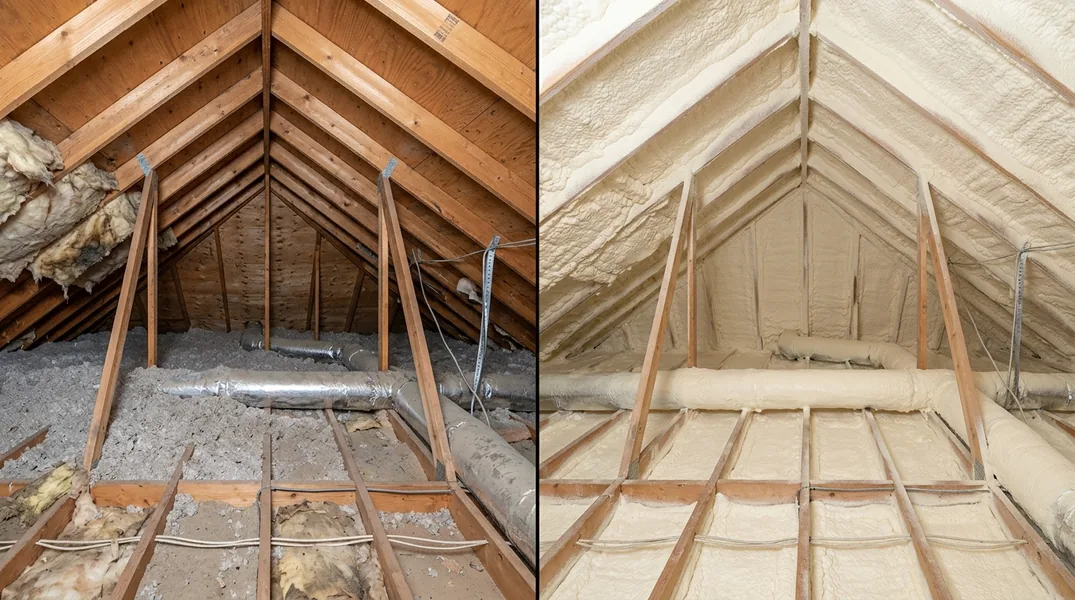
Many Rochester foursquares feature full third-floor attics that homeowners want to convert into living space or at least prevent from becoming thermal disasters. The challenge is that attic insulation in older homes is often degraded, settling, or contaminated with dust, pest droppings, and mold. Removing this old insulation is messy, time-consuming, and exposes homeowners to potential health hazards. Many property owners delay necessary upgrades simply because the prospect of old insulation removal feels overwhelming.
Attic Spray Foam Insulation eliminates the need for complete removal in many cases. The foam can be applied directly over existing insulation or after selective removal of the worst material, creating a continuous thermal barrier that seals air leaks around rafters, collar ties, and penetrations. Closed Cell Spray Foam Insulation offers an R-value of approximately 7 per inch, meaning even a modest 4-inch application delivers R-28 performance in a confined attic space. This approach is faster, less disruptive, and provides superior long-term results compared to traditional attic insulation methods.
Medina Sandstone Basements: Moisture Control and Wall Insulation Solutions
Rochester's distinctive Medina sandstone basements are beautiful but problematic from an insulation standpoint. Sandstone is porous and hygroscopic, meaning it naturally absorbs and releases moisture. During wet seasons or after heavy rain, these basements can develop dampness that encourages mold growth, musty odors, and structural concerns. Traditional fiberglass batts or foam board insulation often trap moisture against the stone, accelerating deterioration and creating conditions that support mold colonies. Homeowners who have attempted to insulate sandstone basements with conventional methods frequently report moisture problems that worsen after the insulation is installed.
Closed Cell Spray Foam Insulation is the superior choice for sandstone basements because it creates a vapor barrier that prevents moisture from migrating through the stone while still allowing the material to breathe slightly. The foam adheres directly to the sandstone surface, eliminating air gaps where mold thrives, and its closed-cell structure resists moisture absorption. Additionally, spray foam's seamless application means no thermal bridges or cold spots where condensation accumulates. For basements with existing moisture issues, proper drainage correction should precede foam application, but once moisture is controlled, spray foam provides lasting protection and dramatically improves basement comfort and usability.
Spray Foam Insulation Problems to Avoid: Hiring the Right Contractor
While spray foam insulation offers remarkable benefits for foursquares and other older homes, improper installation can create serious problems. Spray foam insulation problems typically stem from contractor inexperience, inadequate surface preparation, or failure to account for the material's expansion characteristics. Foam applied over wet surfaces, contaminated substrates, or without proper ventilation considerations can lead to adhesion failures, moisture trapping, or off-gassing issues that affect indoor air quality. Homeowners who hire cut-rate contractors or unlicensed applicators often discover these problems months or years after installation, when remediation becomes expensive and disruptive.
Choosing a qualified, experienced contractor is essential. Rochester Spray Foam Insulation brings decades of combined experience to every project, with technicians trained in proper surface assessment, moisture evaluation, and application techniques specific to older home construction. We understand the quirks of foursquare design, the risks associated with balloon framing, and the moisture dynamics of sandstone basements. Before any foam is applied, we conduct a thorough inspection, discuss your home's unique characteristics, and develop a customized plan that addresses your specific needs. If you're considering spray foam for your foursquare or older Rochester home, call (585) 565-5602 to discuss your project and receive a free estimate.
Attic Spray Foam Insulation Cost in Rochester: What to Budget
The cost of attic spray foam insulation varies based on attic size, existing insulation condition, accessibility, and foam type selection. Open Cell Spray Foam Insulation typically costs less per board foot than closed-cell foam, making it a budget-friendly option for attics where vapor permeability is acceptable. Closed-cell foam costs more but delivers superior R-value, moisture resistance, and structural reinforcement, making it the preferred choice for foursquares with moisture concerns or balloon framing issues. For a typical foursquare attic measuring 600 to 800 square feet, homeowners should budget between $2,500 and $5,000 for comprehensive foam insulation, depending on depth and material selection.
Wall and injection foam insulation for balloon-framed walls costs between $1.50 and $3.00 per board foot, depending on foam type and cavity accessibility. A foursquare with 2,000 linear feet of exterior wall cavities might require 8,000 to 12,000 board feet of foam, translating to a project cost between $12,000 and $36,000. Basement insulation with closed-cell foam typically runs $1,500 to $3,500 for a standard basement, depending on wall square footage. While these numbers may seem substantial, the energy savings, improved comfort, and enhanced home durability justify the investment. To understand the true pricing for your specific home, contact Rochester Spray Foam Insulation for a detailed evaluation and free estimate.
Looking for a professional spray foam insulation contractor in Rochester? Rochester Spray Foam Insulation responds fast for all your spray foam insulation needs.
Get a Free Quote