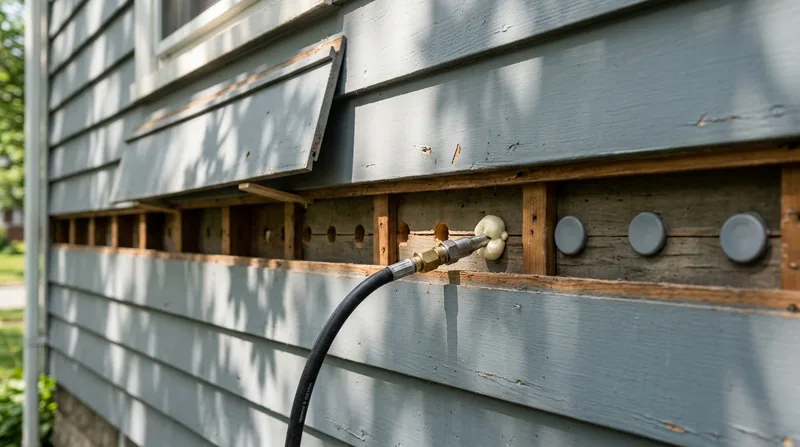




Rochester's 1890s foursquares, Victorian two-families, and post-war capes sit on old basements and under attics that bake in July and ice-dam in January. Many of these homes were built with wall cavities left completely empty, and the only way to fill them without tearing down walls is wall and injection foam insulation. A 1920s balloon-framed house on East Avenue or a 1950s cape in Gates with hollow walls loses heat in winter and gains it in summer through those voids. Injection foam fills those cavities through small drilled ports under a siding course, then patches close behind. No demolition, no mess inside, and the result is a sealed, insulated wall cavity that actually performs. We have been doing this work since 2012 across Rochester, Pittsford, Greece, and the surrounding towns. If your home has original construction and you want to know whether injection foam makes sense for your walls, call us at (585) 565-5602 for a free written estimate with R-value and thickness specs.
Why Wall and Injection Foam Insulation Matters in Rochester's Older Homes
Rochester's housing stock tells the story. Foursquares and Victorians built before 1930 were framed with dimensional lumber and cavity walls meant to breathe, not insulate. Post-war capes and colonials from the 1940s through 1960s often have the same cavity problem: walls that look solid from the outside but are hollow inside. Lake Ontario wind finds every gap. Winter cold pulls heat out through those empty cavities. Summer humidity drives moisture into the walls from outside. A balloon-framed two-family on the 19th Ward or a 1950s ranch in Irondequoit with uninsulated walls is bleeding energy every season.
- Injection foam seals hollow cavities without removing siding or drywall, preserving original exterior trim and interior finishes.
- The process drills small ports under a siding course, injects closed-cell or open-cell foam to fill the void, then patches the holes with matching trim.
- Fire blocking is verified before injection to ensure the foam does not travel into spaces where it should not be.
- Once cured, injection foam becomes rigid and does not settle, unlike blown-in cellulose or fiberglass batts that compress over time.
- The method works for single-story and multi-story walls, masonry veneer over wood framing, and even balloon-framed walls where cavities run from basement to attic.
Injection foam is the retrofit answer for homes that cannot tolerate demolition and where the cavity is accessible from the exterior.
Key info: A 1920s foursquare in Rochester's Neighborhood of the Arts with original wood siding and plaster interior walls can be injection-foamed without touching the inside of the house. Ports go in from the outside under a siding course, foam fills the cavity, and the house stays livable during the work. See how this works for your home: call (585) 565-5602 for a free estimate.
For more information on how spray foam insulation fits into a broader energy strategy for your home, visit our homepage or read about attic spray foam insulation, which often pairs with wall injection work.
How Injection Foam Insulation Works: The Rochester Process
Injection foam starts with a site visit and a clear understanding of what is inside the wall. We identify the framing type, look for fire blocking, verify that the cavity is accessible from the exterior, and check whether the siding can be safely lifted. Once we understand the job, we drill small holes under a siding course (usually the second or third course up from the foundation or from a band board), inject foam at a controlled rate to fill the cavity completely, and then patch the holes with trim that matches the existing siding.
- We schedule a free site visit to assess the wall cavity, identify fire blocking, and confirm that injection is the right method for your home.
- We prepare the exterior by carefully lifting a siding course and identifying the exact locations where we will drill injection ports.
- We drill small holes through the rim board or band joist into the cavity, spaced to ensure complete fill with no voids.
- We inject closed-cell or open-cell foam at a controlled rate, monitoring pressure and fill to prevent over-expansion or incomplete coverage.
- Once the cavity is full and the foam has begun to set, we remove the injection gun, seal the holes with wooden plugs or foam-compatible patches, and reinstall the siding.
- We allow a 24 to 48 hour cure time before the wall is considered fully set, and we ventilate the work area during cure to manage VOCs.
The entire process keeps the interior of your home untouched and is complete in one to three days depending on the size and complexity of the wall.
Example: A 1950s cape in Gates with a 20-foot-long exterior wall over a basement and a knee-wall second story above has two separate cavities to fill: the main wall (16 feet tall) and the knee wall (8 feet tall). Injection foam fills both cavities from the outside without any interior demolition. The homeowner stays in the house, and we work from a ladder with the siding lifted for a few hours per section.
For related work such as rim joist and band joist spray foam, which often pairs with wall injection, we follow the same careful, site-specific approach.
Injection Foam Methods and Materials
| Approach | Description | Best for |
|---|---|---|
| Closed-Cell Injection Foam | High-density foam with R-value of 6.0 to 7.0 per inch, vapor-closed, rigid when set. | Walls exposed to wind, moisture, or temperature swings. Lake Ontario side of Rochester homes and masonry veneer walls where vapor control matters. |
| Open-Cell Injection Foam | Lower-density foam with R-value of 3.6 per inch, vapor-open, softer when set, easier to drill or cut if needed later. | Interior walls, walls not exposed to weather, or homes where cost is a priority and the wall cavity is protected by an exterior air barrier. |
| Partial-Cavity Fill | Foam injected to a specified height or thickness rather than filling the entire cavity. | Budgets where full-cavity fill is not needed, or cavities where structural blocking prevents complete fill. |
| Multi-Section Injection (Balloon Frames) | Cavities in balloon-framed homes injected in sections (basement to first floor, first to second floor, second floor to attic) to account for fire blocking. | Victorian foursquares, two-family homes, and pre-1920s construction where cavities run full-height and fire blocking divides them. |
Wall and Injection Foam Insulation Cost in Rochester: What to Expect
Injection foam pricing in Rochester starts at approximately $2 per square foot of wall cavity and moves up based on the size of the cavity, the type of foam (closed-cell costs more than open-cell), the height and accessibility of the wall, and whether fire blocking requires the cavity to be injected in multiple sections. A 20-foot-long, 10-foot-tall wall section (200 square feet) in a ranch home with straightforward access might run $400 to $500 total. A three-story Victorian foursquare with a 16-foot-tall balloon-framed cavity that requires injection in three sections because of fire blocking will cost more per square foot because of the extra setup, ports, and labor involved.
Factors that move the cost up include:
- Closed-cell foam is 30 to 50 percent more expensive than open-cell because it offers higher R-value and vapor control.
- Multi-section injection (balloon frames with fire blocking) requires more ports and more labor, increasing cost per square foot.
- Difficult exterior access, such as a wall behind a porch or next to a neighbor's property line, adds setup time and safety measures.
- Masonry veneer or stucco exterior requires different drilling and sealing techniques than wood siding.
- Cavity depth and whether the wall includes rim board or band joist sections affects the total volume to be filled.
The best way to understand the cost for your home is to get a written estimate from a contractor who will visit the site, measure the cavity, identify fire blocking, and specify the R-value and thickness of foam recommended. We provide free estimates with full R-value and thickness specs so you know exactly what you are paying for. Visit our pricing page for typical ranges and call (585) 565-5602 to schedule yours.
Wall and Injection Foam Insulation Near Me: What Rochester Homeowners Should Know When Hiring
Finding the right spray foam contractor for injection work means verifying a few key things before you sign a contract. The contractor should be fully insured and should provide proof of coverage on request. They should give you a written estimate with R-value and thickness specs, not a vague price per square foot. They should explain what fire blocking is and whether your cavity has it. They should tell you how long the cure window is and what mechanical ventilation will be in place during cure. And they should be reachable if questions come up after the job is done.
Ask any contractor you are considering:
- Is your company fully insured, and can you provide a certificate of insurance before we start?
- Will you provide a written estimate that includes R-value per inch, foam thickness, and the total board feet of foam to be installed?
- How will you verify fire blocking before injection, and what happens if fire blocking is present?
- What is your cure time and ventilation plan during and after the work?
- Do you have references from homeowners in Rochester or nearby towns where you have done injection foam work?
- Are there any permits required for this work at my address, and if so, who handles them?
Do not accept an estimate with no thickness or R-value specs, and do not book a contractor who promises immediate re-entry or who quotes a price far below what other contractors are quoting. Injection foam work is straightforward, but it requires care, the right equipment, and a contractor who knows the local building code and fire-safety rules that apply at your address. If you have questions about whether injection foam is the right choice for your walls, or if you want to talk through the options, contact us for a free, no-obligation estimate. We serve Rochester, Pittsford, Greece, Irondequoit, Brighton, and all of the surrounding towns.
Wall & Injection Foam Insulation in Rochester: Pricing Guide
| Service | Price | Details |
|---|---|---|
| Open-Cell Injection Foam | Starting at $2/sq ft | Lower R-value per inch, suitable for protected interior walls and budget-conscious retrofits of interior cavities |
| Closed-Cell Injection Foam | Starting at $3/sq ft | Higher R-value, vapor-closed, required for exterior walls, lake-facing homes, and masonry veneer applications |
| Balloon-Frame Multi-Section Fill | On estimate | Victorian and pre-1920s homes with fire blocking require multiple injection points and sections, verified on site before pricing |
| Travel and setup | Included | No separate mileage charge or travel fee for Rochester and surrounding service areas within Greater Rochester |
| Free written estimate | No obligation | Includes R-value, thickness, total board feet, and site-specific notes. Response within 24 hours at (585) 565-5602 |
Indicative pricing, the exact cost depends on square footage, finish, and site access. Free personalized estimate within 24h at (585) 565-5602.


