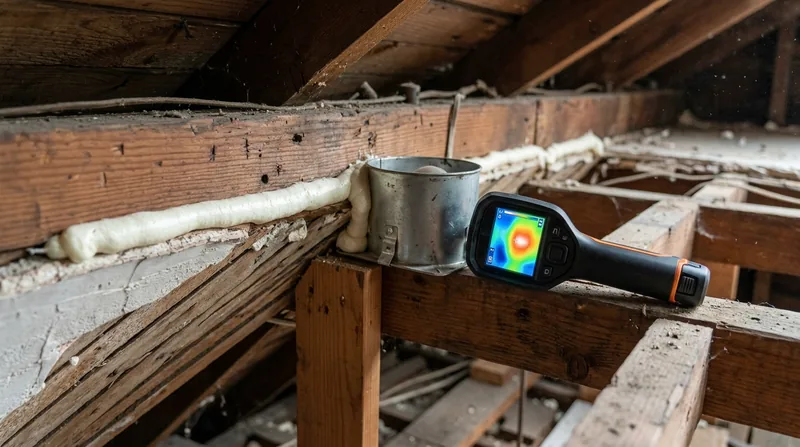




Rochester's winters are relentless. Lake Ontario pumps moisture and wind across the city from November through March, and every gap in your attic framing leaks warm air that builds ice dams on your roof and freezes the rooms below. Top plates, can lights, chimney chases, attic hatches, and rim joists are the culprits. Air sealing in Rochester stops that leak before it costs you thousands in heating and roof damage. We find and seal every gap with spray foam and caulk, then insulate over a tight envelope. It is the cheapest comfort fix in a Rochester house, and the fastest payback on any insulation dollar you spend.
Why Air Sealing Matters in Rochester: Ice Dams, Frozen Bedrooms, and Heating Bills
A Rochester home built before 1990 was framed to breathe. Walls were caulked if you were lucky. Attics were vented. Basements sat on Medina sandstone or limestone with no vapor barrier. That worked when heating ran eight months a year and air conditioning was a window unit. Today, with winter lasting longer and lake-effect snow piling up to the gutters, every unsealed gap in your attic frame becomes a warm-air highway. Heat rises through the attic, melts snow on your roof, and refreezes at the eaves as ice dams that back water into your walls. Meanwhile, the rooms above your basement or garage stay cold because the rim joist leaks like a sieve, and the upstairs bedroom over the garage in a Brighton or Irondequoit cape never reaches comfort because the knee wall has no seal.
- Sealing top plates and can lights stops warm air from rising into the attic and triggering ice dams.
- Closing chimney chases and attic hatches eliminates the stack-effect draft that pulls cold air down into living spaces.
- Sealing rim joists and band joists around basements and crawl spaces prevents cold air from flowing into first-floor rooms and up through wall cavities.
- Sealed attics stay dry because controlled vapor drive prevents humid summer air from condensing on cold surfaces in spring.
These four seals are the foundation of every retrofit we perform, and they are the reason a properly sealed attic with spray foam outperforms a vented attic with blown-in fiberglass every single time in a Rochester winter.
Key info: Rochester gets an average of 130 inches of snow per year, and lake-effect bands dump 2 to 3 feet in a single event. Every pound of that snow on your roof sits on a warm attic underneath it. Seal the air leaks first, insulate second, and you stop ice dams before they start.
For more detail on how spray foam insulation works in sealed attics, see our attic spray foam insulation page.
New York State and Monroe County permit requirements for attic work vary by municipality. Consult your local building department to confirm what applies to your address. You can reach Rochester's Building and Inspections Division at the city website or call the permit counter directly.
How We Air Seal Your Rochester Home: A Step-by-Step Process
Air sealing is not a spray-and-go job. We start with a walk-through of your attic, basement, and rim joists to identify every gap. We photograph leaks, measure the perimeter, note the framing condition, and assess whether the substrate is dry and ready for foam. If there is active moisture, we stop and refer you to a moisture specialist. If the attic is clear, we seal in this order: top plates first, then can lights, then chimney chases, then attic hatches, then any gaps around HVAC penetrations or roof-to-wall transitions. We use low-pressure closed-cell foam on rim joists and band joists where thermal performance and moisture control matter most. We use open-cell or closed-cell on top plates depending on your climate zone and whether the attic will be vented or sealed. Every gap gets sealed before we blow in or spray the main insulation layer. This is the work that separates a professional installation from a rig-and-run crew.
- We inspect the attic, basement, and rim joists to locate all air leaks and assess substrate moisture and condition.
- We seal top plates where the attic framing sits on the exterior wall using closed-cell or open-cell foam depending on your sealing strategy.
- We seal recessed can lights with foam dam and low-pressure foam to prevent heat loss through the fixture housing.
- We seal chimney chases, attic hatches, and HVAC penetrations with closed-cell foam to stop stack-effect drafts.
- We seal rim joists and band joists with low-pressure closed-cell foam to prevent cold air infiltration and control vapor drive.
- We ventilate the space mechanically during cure and confirm re-entry safety before you occupy the area.
The entire process takes one to two days depending on the size of your home and the number of air leaks. A typical Rochester foursquare attic with a full basement rim joist takes four to six hours. A ranch or cape with an unfinished basement and knee walls can take six to eight hours.
Example: A 1920s foursquare in the 19th Ward of Rochester has a balloon-frame attic with a 40-foot top plate, six recessed can lights, an old brick chimney chase, and a pull-down attic hatch. The rim joists are exposed Medina sandstone with mortar joints. We seal the top plate with closed-cell foam at 2 inches, dam and foam each can light, close the chimney chase with foam and caulk, seal the hatch frame, and spray 2 inches of closed-cell on the rim joists. The job takes six hours, includes a 24-hour cure and re-entry window, and costs from $1,200 to $1,500 depending on the exact perimeter and the condition of the can light housings.
For more on the different foam types and their uses, see our pages on closed-cell spray foam and open-cell spray foam.
Air Sealing Methods and Materials
| Approach | Description | Best for |
|---|---|---|
| Closed-cell spray foam | 2-inch layer at 3.5 to 3.8 pounds per cubic foot, cured in 24 hours, R-value 6.5 to 7 per inch. | Rim joists, band joists, rim board on basements, sealed attic top plates where thermal and vapor control are critical. |
| Open-cell spray foam | 3-inch layer at 0.5 to 0.65 pounds per cubic foot, cured in 4 to 8 hours, R-value 3.6 to 3.8 per inch, vapor permeable. | Vented attic top plates, interior wall cavities, sound dampening in garage ceilings, cost-conscious sealing where vapor drive is not a concern. |
| Spray foam dam and low-pressure fill | Closed-cell foam at 1 to 2 pounds per cubic foot applied at low pressure around can light housings, pipe penetrations, and electrical boxes. | Sealing recessed lights, duct penetrations, and small cavities where full-density foam is not needed and cost control matters. |
| Caulk and sealant | Polyurethane or silicone caulk applied to narrow cracks, mortar joints, and transitions after foam cure. | Final sealing of foam edges, chimney chase transitions, attic hatch frames, and gaps too small or irregular for foam. |
Air Sealing Cost in Rochester: What to Expect
Air sealing costs depend on the size of your home, the number of air leaks, the type of foam you choose, and the condition of your attic or basement. A simple top-plate seal on a small ranch or cottage starts at $650 and covers the perimeter, one day of work, and the foam and labor. A full air seal of a Rochester foursquare with rim joists, top plates, can lights, chimney chase, and attic hatch runs from $1,200 to $1,800. A multi-story Victorian with a large attic, multiple chimneys, and a full basement rim joist can run $2,000 to $3,000 or more. The single biggest cost driver is perimeter: a 150-foot top plate costs more to seal than a 100-foot one. The second is access: if your attic is cramped, cluttered, or has low headroom, labor time goes up. The third is foam type: closed-cell is more expensive per board foot than open-cell, but it performs better in cold and wet conditions, so it is worth the cost on rim joists.
We provide a written estimate with the R-value and thickness of every layer, the perimeter in linear feet, the board feet of foam, and the total labor and material cost. We do not charge for the estimate, and there is no obligation to book. Call us at (585) 565-5602 or visit our pricing page for more detail on what moves the cost up or down.
The payback on air sealing is fast. A sealed attic with spray foam insulation typically reduces heating costs by 15 to 40 percent in the first year, depending on how much air leakage you had before. That savings compounds every winter. Over ten years, the cost of sealing your attic pays for itself multiple times over, and you get the comfort benefit of no ice dams, no frozen bedrooms, and no drafts from day one.
What to Look for When Hiring an Air Sealing Contractor Near Rochester
Air sealing is a technical trade, and not every spray foam contractor does it well. Many crews spray foam over air leaks instead of sealing them first, which defeats the purpose. Some spray foam over wet substrates or damp rim joists, which traps moisture and causes mold. Others promise immediate re-entry when the foam is still off-gassing, which is unsafe. Here is how to verify any air sealing contractor you interview, including us.
- Ask for a written estimate that lists the R-value and thickness of every foam layer, the perimeter or square footage being sealed, and the board feet of foam.
- Verify that the contractor is fully insured and ask to see a certificate of insurance naming you as an additional insured for the duration of the work.
- Ask how the contractor handles moisture: if the attic or rim joist is wet, does the contractor dry it first or refer you to a moisture specialist.
- Confirm the re-entry window: legitimate contractors will not allow occupancy for 24 to 48 hours after spray foam cure to allow off-gassing to complete.
- Get references from three recent jobs in Rochester, Greece, Irondequoit, or Penfield, and call them to ask about the quality of the seal and whether any odor or issues arose after the work.
- Check whether your city or town requires a permit for attic or rim joist work, and confirm that the contractor will help you navigate the local process.
The strongest signal of a professional air sealing contractor is an estimate with R-value and thickness on every layer. A price with no R-value, no thickness, and no perimeter measurement is a red flag. So is a price far below market with no inspection, or a promise to finish in an afternoon and leave the same day. Air sealing takes time because it is detailed work, and the payoff depends on getting it right.
When you are ready to get started, contact us for a free estimate. We will schedule a time to walk your attic, basement, and rim joists, answer your questions, and provide a detailed quote with no obligation to book.
Air Sealing in Rochester: Pricing Guide
| Service | Price | Details |
|---|---|---|
| Small air seal (top plate only) | Starting at $650 | Single-story home or cottage with 80 to 120 linear feet of top plate, open-cell or closed-cell foam, one day labor |
| Standard air seal (top plate, can lights, hatch, chimney) | Starting at $1,200 | Two-story home with full attic, four to eight can lights, attic hatch, and chimney chase sealed, closed-cell or open-cell depending on climate |
| Full home air seal (attic and rim joists) | Starting at $1,800 | Top plates, can lights, hatches, chimneys, and basement rim joists sealed with closed-cell foam for thermal and vapor control, two days labor |
| Large Victorian or multi-story seal | On estimate | Complex attic geometry, multiple chimneys, large basement footprint, or unusual framing requires site inspection to measure perimeter and assess access difficulty |
| Travel and mobilization | Included | No separate charge for travel within Rochester, Greece, Irondequoit, Brighton, Pittsford, Penfield, Webster, Henrietta, and surrounding suburbs |
| Free estimate | Free | Written quote with R-value, thickness, perimeter, and total cost, response within 24 hours, no obligation to book, call (585) 565-5602 |
Indicative pricing, the exact cost depends on square footage, finish, and site access. Free personalized estimate within 24h at (585) 565-5602.


