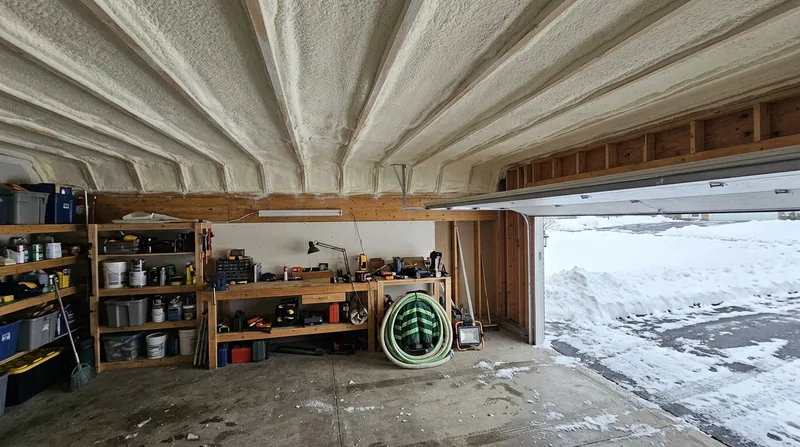




A garage under a bonus room or a workshop conversion in Rochester lives in two worlds at once. In July, the ceiling absorbs heat radiating through asphalt shingles and transfers it down into the space below. In January and February, lake-effect snow piles against the roof while the interior air is heated and humid, and that moisture finds every gap in the rim joist, the top plate, and the shared wall between the garage and the conditioned house. Garage spray foam insulation and air sealing stops both problems. The difference is not a storage box that swings between seasons, but a usable twelve-month space.
Rochester's 1960s-2020s colonials and two-stories over basements often sit with bonus rooms above attached garages. The older capes and bungalows in Greece, Irondequoit, Gates and the inner suburbs have knee-wall bedrooms upstairs that freeze in January because the garage below was never sealed. When the garage is open to the roof deck or separated by a thin rim joist with minimal insulation, the conditioned space above loses money all year. Spray foam stops the thermal bridge, seals the air leaks, and makes the room livable. We help homeowners understand what applies at their address and navigate the process from estimate through cure and re-entry.
Why Garage Spray Foam Insulation Matters in Rochester's Lake-Effect Climate
Lake Ontario drives the weather pattern that defines garage insulation failure in Greater Rochester. Wind off the water finds every gap in the rim joist and the top plate where the garage meets the second story. Lake-effect snow piles up through long winters, and the weight of it on the roof drives moisture and cold down into the garage space. In summer, the roof heats to 140 to 160 degrees Fahrenheit under July sun, and that heat conducts through the ceiling into the bonus room or workshop below. A garage ceiling with no insulation or with settled fiberglass acts as a thermal radiator in both directions.
- Spray foam seals the air leaks that allow cold air and moisture to rise from the unheated garage into the conditioned space above.
- The foam creates a continuous thermal barrier without gaps or settling, so it holds its R-value year after year.
- In winter, it stops the moisture that would otherwise condense on the cold rim joist and rot the framing.
- In summer, it reflects the radiant heat load and keeps the bonus room from becoming an oven.
- A sealed garage also becomes a usable workshop or storage space that does not swing 40 degrees between seasons.
The result is a room you can heat and cool efficiently, and framing that stays dry.
Key info: Rochester's lake-effect snow and winter humidity mean the garage ceiling is a vapor boundary. Spray foam handles both the thermal load and the moisture drive without the settling or compression that fiberglass suffers in high-humidity climates. A properly sealed and foamed garage ceiling in Pittsford or Brighton stays dry and insulated even in the heaviest snow years.
For more on how air sealing works alongside insulation, see our air sealing service page.
How We Insulate and Seal Garage Ceilings in Rochester
The job starts with a site inspection. We look at the garage ceiling, the rim joist, the top plate where the garage meets the second-story walls, and any shared walls between the garage and the conditioned house. We check for existing insulation, moisture, and any obvious air leaks. We ask about the use: is this a bonus room, a workshop, a storage space, or a mix. That tells us whether we are sealing a thermal boundary or a full conditioned space. We then write a detailed estimate with R-value and thickness specifications, so you know exactly what you are getting.
- We inspect the substrate (drywall, rafters, rim joist) and verify it is dry and sound before we spray.
- We seal all air leaks around the rim joist, the top plate, and the shared walls with foam or caulk.
- We apply spray foam to the ceiling in controlled passes, maintaining the manufacturer ratio and drum temperature for proper cure.
- We run mechanical ventilation during the spray and cure phase to manage fumes and VOCs.
- We observe a twenty-four to forty-eight hour re-entry window before the space is occupied or sealed off.
- We provide a written receipt with the R-value, thickness, and coverage area so you have a record for any future work or resale.
The entire process typically takes one to two days, depending on the size of the garage and the complexity of the rim joist.
Example: A 20-by-20-foot garage with a bonus room above in Rochester gets a 5.5-inch closed cell foam ceiling (R-40) plus rim joist sealing. The job runs one day. The bonus room is now usable in January without supplemental heat loss to the garage, and in July the radiant load from the roof is blocked. If the garage also has a workshop conversion, the same foam and air sealing applies, and the space stays comfortable year-round.
For details on closed cell versus open cell foam, see our closed cell spray foam page.
| Approach | Description | Best for |
|---|---|---|
| Closed Cell Ceiling Foam | 5.5 to 7 inches of closed cell foam sprayed to the underside of the roof deck or the garage ceiling joists. R-value R-40 to R-50. Acts as air barrier and thermal barrier simultaneously. | Bonus rooms and workshops where the garage is conditioned or where moisture control is critical. Lake-effect snow regions like Rochester and the inner suburbs. |
| Open Cell Ceiling Foam | 5 to 6 inches of open cell foam sprayed to the same boundary. R-value R-20 to R-25. Lower cost, allows some vapor permeability, good sound dampening. | Unheated garages with bonus rooms above, where the primary goal is to separate the conditioned space from the unheated garage. Sound control is a bonus. |
| Rim Joist and Top Plate Sealing | Foam or caulk applied to the rim joist and the top plate where the garage walls meet the second-story walls or the roof deck. Stops air infiltration and moisture entry. | Every garage insulation job. Rim joist sealing alone is sometimes the right answer if the ceiling is already insulated and the air leaks are the problem. |
| Shared Wall Sealing | Foam applied to the interior face of the shared wall between the garage and the conditioned house. Stops heat loss and air leaks through the wall cavity. | Garages attached to the house. Especially critical in older two-family homes in Rochester's 19th Ward and Beechwood, where the garage is a late addition. |
Garage Spray Foam Insulation Cost in Rochester: What to Expect
Garage spray foam insulation starts at $1,200 for a small garage ceiling with rim joist sealing. The cost moves up based on the size of the garage, the R-value you choose, the complexity of the rim joist, and whether the job includes shared wall sealing or a workshop conversion. A 20-by-20-foot garage with a bonus room above and closed cell foam typically runs $2,500 to $4,000, including rim joist and top plate sealing. An older garage in Greece or Irondequoit with a more complicated rim joist or a larger footprint may run higher.
The best way to understand the cost is to get a detailed written estimate that includes the R-value, the thickness, and the coverage area. We provide that for free, with no obligation to book. Call us at (585) 565-5602 and we will schedule a time to walk the garage, measure the space, and give you a firm number based on what you need. For a full pricing overview and to see how different approaches compare, visit our pricing page.
Travel is included in Rochester and the surrounding areas, so there is no separate call-out fee or mileage charge. If the job is straightforward, you may get an estimate the same day. If the garage has complications (old masonry, moisture issues, or a complex rim joist), we may need to spend more time on the inspection, but the estimate is still free.
Garage Spray Foam Insulation Near Me: What Rochester Homeowners Should Know When Hiring a Contractor
Hiring a spray foam insulation contractor is a decision that affects your home for years. The market has two kinds of operators: rig-and-run crews that spray a garage in an afternoon and disappear when the smell does not go away, and national franchises that charge premium prices and may not have local accountability. A local independent shop with a local address and local plates is positioned between both, and the differentiator is honest guidance and verifiable work.
When you call a contractor, ask for a written estimate with R-value and thickness specifications. If a contractor gives you a price without naming the R-value or the foam type, do not hire them. Ask whether they run mechanical ventilation during the spray and cure, and what re-entry window they observe. If they promise immediate re-entry or say the smell will go away in hours, that is a sign of improper installation. Check their insurance coverage by asking for a certificate of insurance. You can verify any contractor's fully insured status by requesting documentation. Ask for references from jobs they did in the last year in Rochester, Pittsford, Brighton, or Webster, and call those homeowners. Ask about permits. Garage insulation does not always require a permit, but if your job touches the rim joist or involves a sealed attic above, the local building department may have rules. We help you navigate what applies at your address.
- Get written estimates from at least two contractors, and compare the R-value, thickness, and price.
- Ask each contractor for their insurance certificate and verify they are fully insured.
- Request references from recent jobs in your town and actually call them.
- Confirm that the contractor will run mechanical ventilation during the spray and observe a re-entry window of at least twenty-four hours.
- Understand what the local building department requires at your address before you sign a contract.
- Make sure the estimate is free and that there is no obligation to book.
A good contractor will answer every question, provide a detailed estimate, and make the process transparent from start to finish. We are here to help. Call (585) 565-5602 or visit our contact page to request a free estimate.
Garage Spray Foam Insulation in Rochester: Pricing Guide
| Service | Price | Details |
|---|---|---|
| Garage ceiling foam, small garage | Starting at $1,200 | Closed cell or open cell foam to a 16-by-18-foot ceiling with basic rim joist sealing, R-40 or R-25 |
| Bonus room or workshop conversion | Starting at $2,500 | 20-by-20-foot garage, closed cell ceiling foam, rim joist and top plate sealing, R-40 coverage throughout |
| Shared wall plus ceiling and rim joist | Starting at $3,500 | Attached garage with conditioned space above, full insulation and air sealing of ceiling, walls, and rim joist assembly |
| Complex or older garage assembly | On estimate | Masonry rim joist, multiple shared walls, moisture remediation required, or historic structure considerations require site inspection |
| Travel | Included | Rochester and surrounding areas, no separate mileage fee or call-out charge for estimates or jobs |
| Free estimate | No obligation | Written estimate with R-value and thickness, response within 24 hours at (585) 565-5602 |
Indicative pricing, the exact cost depends on square footage, finish, and site access. Free personalized estimate within 24h at (585) 565-5602.


