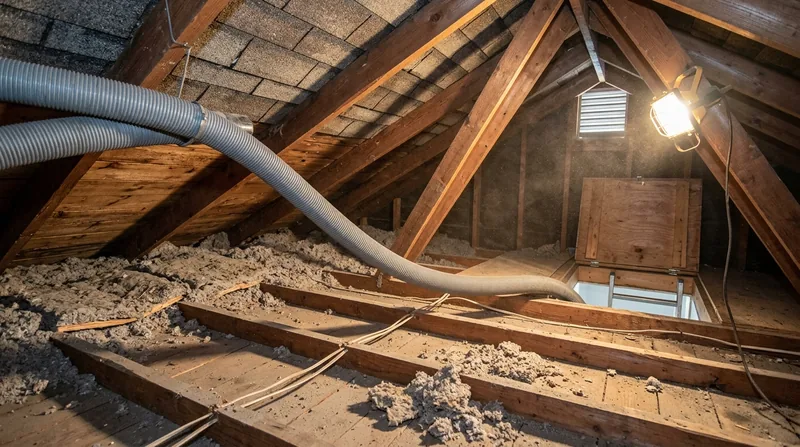




Insulation removal in Rochester is the critical first step before any spray foam retrofit goes in. Rochester's oldest neighborhoods, from the 19th Ward to Beechwood and Park Avenue, sit on balloon-framed structures with decades of settled blown-in cellulose, fiberglass batts, or failed spray foam in their attics. Lake Ontario's brutal winters and lake-effect snow drive ice dams year after year, and the humid summers flip the vapor drive, so any old insulation that has absorbed moisture, settled unevenly, or failed outright has to come out entirely before new foam can seal the assembly right. We vacuum out every scrap of old material, never bury it, and when we find vermiculite in older Rochester attics, we flag it for testing and leave it alone. The job most installers will not touch is cutting out failed spray foam, and that is exactly the work we do.
Why Insulation Removal Matters in Rochester's Aging Housing Stock
Rochester was built in waves: 1890s-1920s balloon-framed foursquares and Victorians in the inner city, 1940s-1960s capes and bungalows in Greece, Irondequoit, and Gates with knee-wall bedrooms that freeze in January, and post-1960s colonials over basements in Brighton, Pittsford, and Penfield. Every one of these homes was insulated with whatever was standard at the time, and almost all of it has failed or settled. Blown-in cellulose compacts over decades. Fiberglass batts absorb moisture from the humid summers and the condensation that forms when ice dams back up water into the attic. Old spray foam, installed without proper ventilation or thickness control, shrinks, cracks, and pulls away from the rim joists and top plates. When you layer new foam over failed insulation, you trap the old material's moisture and the new foam's cure moisture in the assembly, and the whole thing rots from the inside out.
- Settled blown-in insulation no longer provides the R-value on the label and leaves gaps where warm air escapes into the attic in January.
- Fiberglass batts absorb water from ice dams and summer humidity, losing insulating value and creating conditions for mold.
- Failed spray foam cracks and pulls away from framing, leaving thermal bridges and air leaks that no amount of new foam on top can fix.
- Vermiculite, common in Rochester attics built before 1980, may contain asbestos and must be tested by a licensed professional before any work proceeds.
- Removing all old insulation lets us seal the assembly with the right foam, at the right thickness, with proper ventilation during cure, so the job holds for decades.
Proper removal is not optional; it is the foundation of every retrofit that works in Rochester's climate.
Key info: Rochester sits on Lake Ontario where ice dams and lake-effect snow are routine. Old insulation that has absorbed moisture from ice dam backups or summer humidity has to come out entirely before new foam goes in, or the assembly will rot from the inside. We do not cover failed insulation with new foam; we remove it first.
For guidance on what the New York State building code requires at your address, contact your local building department. Rochester's Building Division, the Town of Greece Building Department, and the Town of Penfield Building Department each have specific rules about ventilation and thermal barriers that govern what foam can go where.
How We Remove Insulation in Rochester: Step by Step
Removal is mechanical and methodical. We bring a truck-mounted vacuum system to your home, seal off the attic or crawl space, and pull every scrap of old insulation into the rig. For failed spray foam, we cut it out section by section, working around framing and electrical runs. We bag and haul everything off site. Once the space is bare, we inspect the substrate, check for moisture, and report what we find before any new foam goes in. If there is active moisture, we stop and walk away. If the deck is sound and dry, we schedule the spray.
- We set up negative air with mechanical ventilation to control dust and odor during removal.
- We vacuum all blown-in insulation into a truck-mounted system and haul it off site for proper disposal.
- We cut out failed spray foam with hand tools, working carefully around electrical wiring and plumbing runs.
- We inspect the substrate for water damage, mold, or active moisture before we leave the job.
- We flag vermiculite for testing and do not disturb it; we work around it and note its location in our report.
- Once removal is complete, we provide a written estimate for the new foam, specifying R-value and thickness so you know exactly what you are getting.
The result is a clean, dry, bare assembly ready for new foam to seal it right.
| Approach | Description | Best for |
|---|---|---|
| Blown-in removal | Truck-mounted vacuum pulls cellulose, fiberglass, or mineral wool into the rig; no dust escapes into living spaces below. | Attics with settled or wet blown-in insulation; crawl spaces with loose fill. |
| Failed spray foam removal | Hand tools cut out cracked, shrunk, or poorly installed foam; sections are bagged and removed; the substrate is inspected for damage. | Attics and sealed roof decks where previous spray foam has failed or does not meet spec. |
| Selective removal | We remove insulation from one zone or section of the attic while preserving sound material elsewhere, if the homeowner requests it. | Partial retrofits where some insulation is still serviceable and the budget limits work to one area. |
| Vermiculite flagging | We identify vermiculite, do not disturb it, and recommend the homeowner hire a licensed asbestos professional for testing and safe removal if needed. | Rochester attics built before 1980 where vermiculite is visible; common in the 19th Ward and older East Avenue homes. |
Example: A 1920s foursquare in the 19th Ward has 8 inches of settled cellulose in the attic. We arrive with the vacuum rig, seal the attic, pull every bit of material, and haul it off. The homeowner gets a clean attic and a written estimate for new closed-cell foam to seal the rim joists and stop the ice dams. A Penfield colonial from 1975 has failed spray foam that is cracked and pulling away from the rim. We cut it out, inspect the substrate for water damage, and if it is dry, we estimate new foam at the correct thickness. The job takes 4 to 6 hours; the homeowner can re-enter 24 to 48 hours after the spray is complete.
For more detail on how spray foam insulation works after removal is done, see our attic spray foam insulation page.
Insulation Removal Cost in Rochester: What to Expect
The cost of insulation removal in Rochester starts at around $950 for a straightforward attic with settled blown-in material and good access. That price covers the vacuum rig, labor, and haul-off of the material. The cost moves up if the attic is large, if access is tight, if failed spray foam has to be cut out by hand, or if the job involves multiple zones like an attic plus a crawl space. A 1,500-square-foot attic with 10 inches of compacted fiberglass and some failed foam patches might run $1,500 to $2,000. A crawl space with wet insulation and structural debris costs more because the material is heavier and removal takes longer. The best way to know what your job will cost is to get a free estimate from a contractor who will visit your home, assess the scope, and give you a written price before any work starts.
We provide written estimates with R-value and thickness specs so you understand exactly what removal will cost and what new foam will be installed afterward. Our estimate response time is 24 hours, and the estimate itself is free and no obligation. Call us at (585) 565-5602 or visit our pricing page to see the full range of costs for removal and re-insulation across Rochester and the suburbs.
Insulation Removal Near Me: What Rochester Homeowners Should Know When Hiring
When you are ready to remove old insulation and install new foam, there are a few things to check before you hire. First, verify that any contractor you hire is fully insured; ask to see the certificate and confirm the coverage amount. Second, get at least two or three estimates so you can compare scope, price, and the contractor's understanding of your specific situation. Third, ask for references from jobs completed in your neighborhood or your ZIP code; a contractor who has worked in Rochester for years will have recent work nearby. Fourth, understand your local permitting rules. Rochester and the surrounding towns each have their own building department, and some jobs require permits. Ask your contractor to help you navigate what applies at your address, but the final call comes from your local building department. Finally, if you have an HOA or live in a historic district, check whether any exterior work needs architectural approval.
- Confirm that the contractor is fully insured and can provide proof of coverage before work begins.
- Get written estimates from at least two contractors so you can compare scope, price, and timeline.
- Ask for references from recent jobs in your area, and call them to ask about the quality of the work and the contractor's professionalism.
- Understand your local building department's rules about ventilation, thermal barriers, and permits; ask your contractor to explain what applies at your address.
- Check with your HOA or local historical society if you live in a restricted neighborhood; some exterior work requires architectural approval.
- Avoid contractors who promise immediate re-entry, give estimates with no R-value or thickness specification, or charge far below the market rate with no inspection.
A local contractor with years of work in Rochester knows the climate, the building stock, and the permitting landscape. That knowledge is worth the phone call.
Ready to get started? Contact us for a free estimate, or call (585) 565-5602 to discuss your removal and re-insulation project. We have been in business since 2012 and work across Rochester, Greece, Irondequoit, Brighton, Pittsford, Penfield, Webster, and the surrounding towns.
Insulation Removal in Rochester: Pricing Guide
| Service | Price | Details |
|---|---|---|
| Standard attic removal | Starting at $950 | Blown-in insulation vacuum removal, 1,000 to 1,500 sq ft attic, good access, haul-off included |
| Failed spray foam removal | Starting at $1,200 | Hand-cut removal of cracked or shrunk spray foam, inspection of substrate, labor-intensive removal from multiple zones |
| Large attic or crawl space removal | Starting at $1,800 | Attics over 1,500 sq ft, crawl spaces with wet or heavy insulation, tight access, multiple zones requiring separate work |
| Removal plus new spray foam | On estimate | Removal cost plus new closed-cell or open-cell foam at specified R-value and thickness; total price depends on square footage and foam type |
| Travel | Included | No separate mileage fee or travel charge for jobs in Rochester and surrounding service areas |
| Free estimate | No charge | Written estimate with specifications, 24-hour response time, no obligation to book; call (585) 565-5602 |
Indicative pricing, the exact cost depends on square footage, finish, and site access. Free personalized estimate within 24h at (585) 565-5602.


