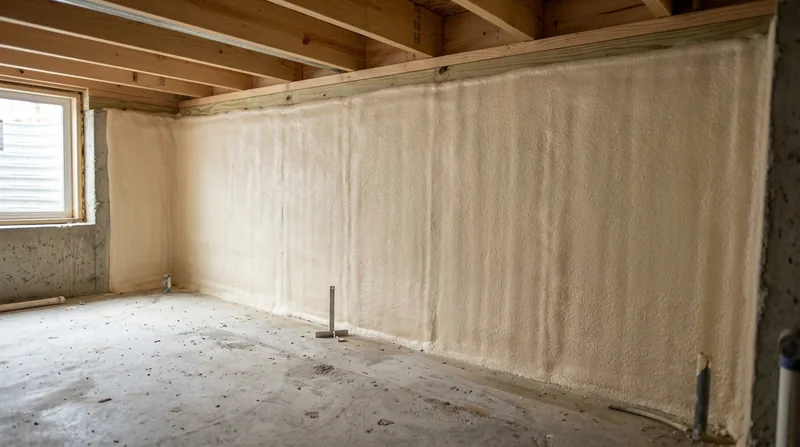




Rochester homeowners and property managers face a singular challenge: lake-effect snow, winter wind off Lake Ontario, and summer humidity that reverses the vapor drive twice a year. Basements sit on Medina sandstone or limestone block that sweats in spring. Rim joists and band joists leak cold air into knee-wall bedrooms. Pole barns and metal buildings frost solid inside come January. Closed cell spray foam insulation delivers R-6.5 per inch with its own vapor retarder and structural stiffening, the right answer for any Rochester assembly that has to handle both a lake-effect January and a humid August. We have been installing spray foam insulation across Greater Rochester since 2012, and we know exactly where the cold comes in and why.
Why Closed Cell Spray Foam Matters in Rochester: The Lake Effect Reality
Rochester sits on the south shore of Lake Ontario where wind off the water finds every gap in your home's envelope. Lake-effect snow stacks up through long winters, and when it melts and refreezes, it exposes every air leak and every cold bridge. Basement walls built from 1890s-era sandstone or poured concrete block absorb moisture from the surrounding soil and release it into living space. Rim joists on 1940s and 1950s capes and bungalows are original balloon framing with no insulation at all. Metal pole barns and equipment sheds in Wayne County and Livingston County frost inside from March through May when soil thaw releases moisture. Closed cell foam stops all three failure modes: it seals the air leaks, it works as a vapor retarder so moisture does not migrate into the conditioned space, and it provides the structural stiffening that loose-fill insulation cannot.
- Closed cell foam adheres to foundation walls and rim joists, stopping cold air infiltration at the source where loose-fill fiberglass leaves gaps.
- The foam itself acts as a vapor retarder, so you do not need a separate polyethylene barrier that can trap moisture in the wall cavity.
- Two-pound density closed cell resists moisture absorption, critical for basements and crawl spaces where humidity is constant.
- The foam stiffens the assembly, important for metal buildings and post-frame barns where condensation and frost are the failure mode.
- Closed cell spray foam meets code ignition and thermal barrier requirements when applied at the correct thickness and with the correct facing.
Every Rochester basement, every rim joist, and every metal building we spray gets the same honest assessment: closed cell works here because Rochester's climate demands it.
Key info: Rochester's lake-effect snow and humidity reversal mean your attic can frost in January and sweat in August. Closed cell foam with its integrated vapor retarder handles both seasons without a separate barrier that can trap moisture. The 15-minute thermal barrier distinction matters: closed cell at the code-specified thickness meets this requirement, and the building official at your address will verify it, not us.
For detailed information on New York building code requirements for spray foam insulation, consult the New York Department of State and your local building department. Rochester, Greece, Irondequoit, Brighton, and Pittsford each have their own code enforcement office, and permitting rules are not reciprocal across the county.
How We Install Closed Cell Spray Foam Insulation in Rochester: The Process
Closed cell spray foam installation is a controlled sequence, and every step matters. We do not spray over wet, contaminated, or leaking substrates. We measure the substrate temperature, the drum temperature, and the ambient conditions before we start. We apply the foam in passes that do not exceed the manufacturer's thickness per pass, typically 1.5 to 2 inches at a time. We run mechanical ventilation during cure and establish a 24 to 48-hour re-entry window. We then trim the foam flush to the framing and install the required thermal barrier facing if the application calls for it. We walk away from any job where the conditions are not right, and that honesty is what separates us from the rig-and-run outfits that spray in an afternoon and disappear when the smell will not go away.
- We inspect the substrate and identify any moisture, leaks, or contamination before we mobilize equipment.
- We verify drum temperature, material ratio, and spray gun calibration on every job.
- We apply closed cell in controlled passes, never exceeding the manufacturer thickness per pass to ensure proper cure and density.
- We run mechanical ventilation during cure and post a 24 to 48-hour re-entry window on the job.
- We trim foam flush to the framing and install thermal barrier facing where code requires it.
- We provide a written estimate with R-value and thickness specifications before any work begins.
A typical basement wall retrofit in a Rochester home takes one to two days depending on the square footage and the number of rim joists. A pole barn in Livingston County may take longer because of the building envelope size and the need to manage ventilation during cure in an open structure.
Example: A 1950s cape in Irondequoit with an uninsulated rim joist and a damp basement wall gets closed cell spray foam applied to the rim joist band and the foundation wall up to the rim. The job takes one day. The homeowner sees a drop in heating bills by January and no more frost on the basement window in February. The smell is present during cure and for a few hours after, then clears completely.
For more on air sealing around spray foam and how it ties into your whole-home insulation strategy, see our air sealing service page.
Closed Cell Spray Foam Insulation Methods: Which Approach Works for Your Job
| Application | Description | Best for |
|---|---|---|
| Foundation Wall and Rim Joist | Two-pound closed cell sprayed directly to the concrete or masonry, typically 2 to 3 inches thick. Vapor retarder integrated. Thermal barrier facing applied if required by code. | Basements in Rochester, Penfield, and Pittsford where moisture and cold infiltration are the failure modes. |
| Pole Barn and Metal Building Walls | Closed cell applied to the interior side of metal or wood studs in post-frame buildings. Thickness typically 2 to 4 inches. Condensation control is the primary goal. | Equipment sheds, fruit storage barns, and machine sheds in Wayne and Livingston counties where frost and moisture damage equipment and stored goods. |
| Attic Rim and Knee Wall Walls | Closed cell applied to knee walls and rim joists in attics and finished half-story spaces. Provides both insulation and air sealing. Vapor retarder integrated. | 1890s-1920s foursquares and Victorians in the 19th Ward and South Wedge where finished attic rooms freeze in January. |
| Retrofit Wall Injection | Closed cell injected into the cavities of existing balloon-frame or stud walls without demolition. Holes drilled from inside or outside, foam injected, holes patched. | Pre-1980 homes in Rochester and suburbs where original walls have no insulation and demolition is not an option. |
Closed Cell Spray Foam Insulation Cost in Rochester: What to Expect
Closed cell spray foam insulation starts at $1.20 per board foot in the Rochester market, and the actual cost depends on the scope, access, and substrate condition. A simple rim joist retrofit on a single-family home in Brighton might run $800 to $1,500. A full basement wall retrofit on a 1950s cape in Irondequoit could range from $2,000 to $4,000 depending on the square footage and whether the wall is already partially insulated. A pole barn in Livingston County with significant square footage and multiple exterior walls will require an on-site estimate because the board-foot volume is too large to estimate remotely.
What moves the price: the total square footage you are covering, the thickness the application requires (rim joists typically need 2 to 3 inches; foundation walls often 2 to 4 inches), whether the substrate needs preparation or repair before spraying, and whether a thermal barrier facing is required by code at your address. Two to three written estimates from contractors who specify R-value and thickness are the right approach. We provide a free written estimate within 24 hours at (585) 565-5602, and we do not ask for a credit card or commit you to anything.
For a detailed pricing breakdown and to see how different scopes affect the bottom line, visit our full pricing page.
Closed Cell Spray Foam Insulation Near Me: What to Look for When Hiring a Contractor in Rochester
Spray foam insulation is not a commodity. The difference between a contractor who controls temperature, material ratio, and thickness and one who does not is the difference between a job that holds for twenty years and one that smells for weeks and fails inside three years. When you are shopping for a closed cell spray foam contractor near Rochester, look for these markers of competence and honesty.
- A written estimate that names the R-value per inch and the thickness in inches, not a vague "we will spray your basement" with a price attached.
- A contractor who asks about moisture and substrate condition before committing to a price, and who will walk away from a wet or contaminated job.
- Insurance verification: ask for a certificate of insurance and confirm the policy is active; do not accept a verbal "we are insured."
- References from homeowners or commercial clients in your area who had spray foam installed in the last two years, and a willingness to let you call them.
- A clear statement of the re-entry window (typically 24 to 48 hours) and mechanical ventilation during cure, not a promise to let you back in immediately.
- Understanding of local code: the contractor should know whether your job requires a thermal barrier, what the building official at your address requires, and should defer to the local building department, never claim to override it.
Bad spray foam work is recognizable by behavior, not by price alone. An estimate with no R-value and no thickness, a price far below market with no inspection, a promise of immediate re-entry, and insurance that cannot be verified are the hallmarks of a rig-and-run operation. We are fully insured, we provide written estimates with R-value and thickness, and we are reachable after the job is done. For a free estimate and to discuss your specific job, contact us at (585) 565-5602.
Closed Cell Spray Foam Insulation in Rochester: Pricing Guide
| Service | Price | Details |
|---|---|---|
| Rim Joist and Band Joist Retrofit | Starting at $1.20/board ft | Two to three inches of closed cell applied to rim joist and band joist, includes material, labor, and trim. Cost depends on linear feet and accessibility of the joist. |
| Foundation Wall Insulation | Starting at $1.20/board ft | Two to four inches of closed cell applied to basement or crawl space walls, includes substrate prep, foam, thermal barrier if required by code. Price rises with wall height and square footage. |
| Pole Barn and Metal Building Walls | Starting at $1.20/board ft | Two to four inches of closed cell applied to interior of metal or wood studs, includes ventilation management during cure. Large footage requires on-site measurement before final estimate. |
| Wall Injection Retrofit (Existing Walls) | On estimate | Closed cell injected into cavities of balloon-frame or stud walls without demolition. Requires on-site inspection to assess cavity condition, obstruction, and access holes needed. |
| Travel | Included | No separate travel fee or mileage charge for jobs in Rochester and surrounding service area towns. |
| Free Written Estimate | Free | Response within 24 hours at (585) 565-5602. Estimate includes R-value, thickness, and scope. No obligation to book. |
Indicative pricing, the exact cost depends on square footage, finish, and site access. Free personalized estimate within 24h at (585) 565-5602.


