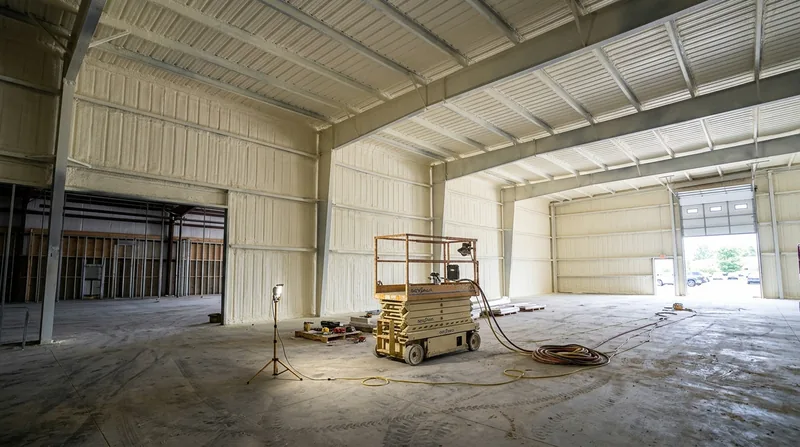




Commercial and new construction spray foam insulation in Rochester demands more than a weekend crew and a trailer. Eastman Business Park, Henrietta, Victor and the industrial zones around Greater Rochester run warehouses, offices, production facilities and spec shells where thermal performance and code compliance cannot wait for a callback. Lake Ontario drives the weather: wind off the water finds every gap in an uninsulated shell, lake-effect snow piles up through long winters, and humid summers flip the vapor drive so every assembly has to handle both seasons. New construction and major commercial retrofits need phased work that keeps your operation running, documentation your building department will accept, and a contractor who understands the difference between a sealed roof deck and a vented attic, and knows when to walk away from a wet substrate. Rochester Spray Foam Insulation has served commercial builders, property managers and facility owners since 2012 with code-compliant assemblies and on-schedule delivery.
Why Commercial and New Construction Spray Foam Matters in Rochester's Industrial Corridor
Commercial shells and new builds in Rochester face a harsh thermal envelope challenge. The Genesee Valley and the industrial zones of Henrietta and Victor experience wide seasonal swings: baking summer heat that drives cooling loads, long winters with heavy lake-effect snow, and the wind and moisture that come off Lake Ontario. A warehouse or office with gaps in the insulation envelope bleeds energy year-round. Spray foam closes those gaps permanently, creates a continuous thermal barrier, and eliminates the air leakage that fiberglass or mineral wool cannot address. For new construction, closed-cell foam on a sealed roof deck prevents condensation on steel and concrete decks. For retrofits, it fills irregular cavities and rim joists that blown-in insulation misses. The result is lower operating costs, fewer HVAC callbacks, and a building that meets code the first inspection.
- Spray foam seals the entire thermal envelope in a single pass, eliminating air leakage that drives HVAC load and humidity control failures.
- Closed-cell foam prevents condensation on metal roof decks and steel beams by creating a continuous vapor barrier.
- The material conforms to irregular shapes, rim joists, and structural details that standard batts or blown-in cannot cover.
- Code-compliant thickness and R-value come documented on every job so your building department approves it the first time.
- Phased application keeps your facility operational during construction or retrofit without shutting down production.
Warehouses and production facilities in Rochester that choose spray foam report faster HVAC response, fewer thermal complaints, and energy performance that meets spec sheet promises.
Key info: New York State building code requires thermal and ignition barriers on spray foam in commercial buildings. The fifteen-minute thermal barrier is the distinction most generalists get wrong. We design and install assemblies that pass your local building department's interpretation of the code at your address. Permitting and registration vary from city to city across Greater Rochester, and we defer to the building official at your location.
For more detail on how thermal barriers and code compliance work in your specific building, contact your local building department or request a free commercial estimate and we will walk through the requirements with you.
How We Execute Commercial and New Construction Spray Foam in Rochester
Commercial spray foam work requires coordination, planning and precision. We begin with a site visit to assess the substrate, identify moisture, plan the application sequence, and confirm what permits and thermal barrier design apply at your address. We then schedule the work to fit your construction timeline or operational window. Our crew arrives with equipment sized for the job, applies foam in controlled passes with mechanical ventilation running, documents coverage and thickness, and provides your building department with a written specification that includes R-value, thickness, and material data. We do not spray over wet, contaminated or leaking substrates. We fix the moisture first or we walk away.
- We schedule a site walk with your general contractor or facilities manager to confirm substrate, access, and code requirements before we bid.
- We deliver a written estimate that names R-value, thickness in inches, and the thermal and ignition barrier assembly required by your building code.
- We apply foam in controlled passes, maintain mechanical ventilation during cure, and enforce a re-entry window of twenty-four to forty-eight hours before occupancy.
- We provide documentation to your building department that includes material specifications, application thickness, and installer credentials so permit approval moves forward without delay.
- We coordinate with your schedule so the work does not shut down your operation or conflict with other trades.
The result is a code-compliant assembly that passes inspection and performs as designed for the life of the building.
Example: A spec warehouse in Henrietta with an uninsulated metal roof deck scheduled foam application in three phases over eight weeks, keeping loading dock access open and minimizing disruption to the tenant's move-in timeline. We sprayed closed-cell foam on the interior face of the deck, installed the required thermal barrier, and delivered a signed certificate of compliance to the building department before the first occupancy permit was issued.
For details on how we coordinate with your construction schedule, see our metal building and barndominium insulation page or call (585) 565-5602 to discuss your project timeline.
Methods: Closed Cell, Open Cell, and Injection Foam for Commercial Work
| Approach | Description | Best for |
|---|---|---|
| Closed-Cell Spray Foam | Dense, rigid foam with R-value 6.0 to 7.0 per inch. Creates a vapor barrier and resists moisture. Requires thermal barrier in commercial buildings. | Metal roof decks, sealed attics, crawl spaces, rim joists, and any assembly where condensation control is critical. |
| Open-Cell Spray Foam | Softer, semi-rigid foam with R-value 3.5 to 4.0 per inch. Allows vapor transmission. Lower cost per board foot. Requires thermal barrier in commercial buildings. | Interior walls, attic cavities where vapor permeability is acceptable, and buildings where acoustic dampening adds value. |
| Injection Foam (Closed Cell) | Low-pressure closed-cell foam injected into existing wall cavities through small holes. Fills the cavity without demolition. Achieves R-value 3.5 to 5.5 per inch depending on cavity depth. | Retrofit of existing commercial walls, historic buildings where exterior demolition is not allowed, and buildings where interior access is limited. |
| Spray Foam on Sealed Roof Deck | Closed-cell foam applied to the interior face of a metal or concrete roof deck. Creates continuous insulation and vapor control. Eliminates condensation on steel beams and purlins. | New construction warehouses, production facilities, and retrofits where the roof deck is exposed to interior humidity or wide temperature swings. |
The choice between closed-cell and open-cell is dictated by the assembly, the climate, and the use. Closed-cell is the default for commercial work because it handles the moisture and condensation loads that Lake Ontario's humid summers and cold winters create. On a sealed roof deck, closed-cell is non-negotiable. On interior retrofit walls in a dry office space, open-cell may be the right answer and we will say so. Learn more about closed-cell spray foam or open-cell options for your specific application.
Commercial and New Construction Spray Foam Cost in Rochester: What to Expect
Commercial spray foam pricing in Rochester depends on the scope of work, the substrate, access, and the thermal barrier assembly required by your building code. A free commercial estimate is the only honest starting point because every warehouse, office shell, and retrofit is different. A 5,000-square-foot warehouse roof deck with good access and a straightforward closed-cell application will cost less per board foot than a retrofit of an irregular attic or a job with limited access. New construction where foam is planned into the schedule moves faster and costs less than a retrofit where the substrate must be cleaned, dried, or prepared. Permit requirements and thermal barrier design also affect the final bid.
We deliver a written estimate that breaks down the board footage, R-value, thickness, material cost, labor, and the thermal barrier assembly so you understand what you are paying for and why. We do not quote a price per square foot or per board foot in advance because that invites cutting corners on thickness or ratio to hit a number. You get one price for the complete, code-compliant job. If you want to compare, get 2 or 3 estimates from other contractors and ask each one to specify R-value, thickness, and the thermal barrier assembly in writing. The lowest number will often come with shortcuts that fail inspection or perform poorly.
For a detailed breakdown of typical costs and what moves the price up or down, visit our full pricing overview or request a free commercial estimate at (585) 565-5602.
What to Look for When Hiring a Commercial Spray Foam Contractor Near Rochester
The spray foam market in Rochester includes local independents, national franchises, and rig-and-run crews that trailer in from out of state, spray a job in an afternoon, and disappear when the smell will not go away or the foam fails inspection. A good contractor is fully insured, delivers a written estimate with R-value and thickness, and can explain the thermal barrier requirement for your specific building code. Ask for references from recent commercial jobs in Rochester or nearby. Call at least two of them and ask if the work passed inspection the first time and if they would hire the same contractor again. Check that the contractor's insurance is current and that they will provide a certificate of insurance naming your project. Avoid any contractor who promises a price per board foot, who offers immediate re-entry (the cure window is twenty-four to forty-eight hours minimum), or whose estimate has no R-value or thickness specification.
Permits and registration requirements vary from city to city across Greater Rochester and there is no reciprocity, so verify that any contractor you hire is registered or permitted to work in your specific municipality. Ask your building department which contractors they recognize and which ones have a track record of passing inspection. A local shop with a local address and local plates, one that has served the Rochester market for years, is positioned against both the national franchise and the out-of-state trailer crew. Honest guidance is the differentiator: the contractor who tells you when blown-in insulation is the right answer instead of foam, or who walks away from a wet substrate, is the one worth hiring.
Ready to move forward? Contact us for a free estimate or call (585) 565-5602 to discuss your project with someone who knows the Rochester market and your building code.
Commercial & New Construction Spray Foam in Rochester: Pricing Guide
| Service | Price | Details |
|---|---|---|
| Free commercial estimate | Free | Site visit, substrate assessment, code requirements review, and written bid with R-value and thickness specification |
| Closed-cell spray foam | Starting at $1.50 to $2.50 per board foot | Sealed roof decks, crawl spaces, rim joists, and assemblies requiring vapor and condensation control in Rochester's humid climate |
| Open-cell spray foam | Starting at $0.85 to $1.35 per board foot | Interior walls, attic cavities, and retrofit applications where vapor permeability is acceptable and cost is a factor |
| Injection foam retrofit | Starting at $1.25 to $2.00 per board foot | Existing wall cavities without demolition, historic buildings, and tight-access retrofits across Rochester and surrounding areas |
| Travel and mobilization | Included | No separate mileage fee or travel charge within Rochester and all surrounding service areas |
| Thermal barrier and code compliance | Included in estimate | Assembly design, material, labor, and documentation for your local building department inspection and permit approval |
Indicative pricing, the exact cost depends on square footage, finish, and site access. Free personalized estimate within 24h at (585) 565-5602.


