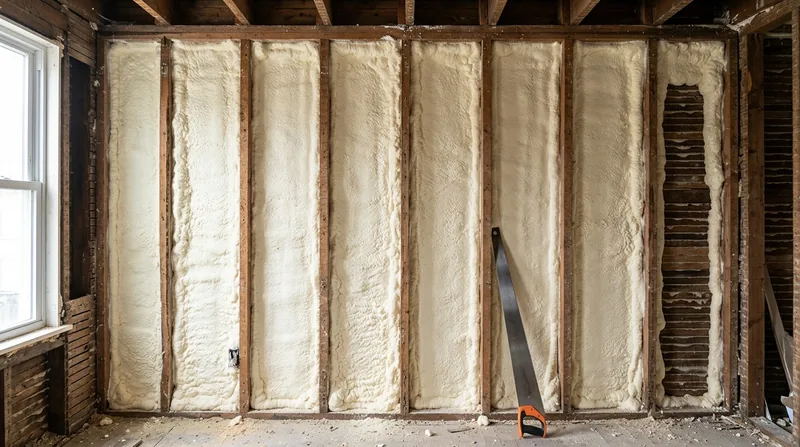




Open cell spray foam insulation in Rochester costs less per board foot than closed cell, air-seals attics and walls just as effectively, and brings sound dampening between floors of a two-family home as a bonus. Lake Ontario drives the weather here: wind off the water finds every gap in an attic, lake-effect snow piles up through long winters, and humid summers flip the vapor drive so every assembly has to handle both seasons. The old Medina sandstone basements, the balloon-framed foursquares and Victorians of the 19th Ward, the knee-wall bedrooms in the 1940s capes of Greece and Irondequoit, and the bonus rooms above garages in the newer colonials of Brighton and Pittsford all suffer the same failure: thermal bridging through rim joists, air leakage at the attic plane, and condensation when the indoor humidity meets a cold roof deck in January. Half-pound open-cell foam stops the leak and the thermal loss at a price that makes sense for a sound attic or a retrofit wall. We spell out where it belongs, and where a basement wall or a metal building calls for closed cell instead. Call (585) 565-5602 for a written estimate with R-value and thickness specs, or read on to understand the job.
Why Open Cell Spray Foam Matters in a Rochester Attic
Ice dams are the signature failure of a Rochester attic. Lake-effect snow sits on a roof deck warmed by heat loss from below, melts, refreezes at the eave where the deck is cold, and backs water under the shingles. The root cause is not the snow: it is the air leak and thermal bridge that warm the deck in the first place. Fiberglass batts and blown-in cellulose do not stop air movement, so a attic full of either one still leaks around the rim joist, the top plate of the exterior wall, and every wire and pipe that penetrates the attic floor. Open-cell foam seals all of it in one pass, cuts the heat loss, and keeps the deck cold so the snow does not melt.
- Open-cell foam expands to fill cavities and gaps, stopping air leakage that fiberglass cannot reach.
- The lower density (half a pound per cubic foot) means easier installation and lower cost per board foot than closed cell.
- Sound dampening between the upper and lower units of a two-family home comes with the material itself.
- Correct installation requires mechanical ventilation during cure and a stated re-entry window of twenty-four to forty-eight hours.
- Open-cell foam is vapor-permeable, so it works in both winter (condensation control) and summer (humid air can dry through the foam).
The result is a warmer attic floor in winter, no ice dams, and lower heating bills. We also handle attic spray foam insulation in closed cell where a sealed roof deck or a metal building demands it.
Key info: New York State building code requires a thermal barrier (a material rated to limit flame spread) between the foam and the living space. A drywall layer, a rubber membrane, or a proprietary intumescent coating all satisfy this. The fifteen-minute thermal barrier distinction is the one most generalists get wrong, and naming it correctly is itself the expertise signal. Your local building department in Rochester, Greece, Irondequoit, or anywhere in the service area will tell you what applies at your address.
How We Install Open Cell Spray Foam in Rochester Attics and Walls
Every job starts with a site visit. We measure the attic or wall cavity, assess the substrate for moisture, check for any existing insulation or obstructions, and verify what the local building department requires at your address. We then give you a written estimate with R-value and thickness specs so you know exactly what you are paying for. Once you approve, we schedule the work, bring in the spray rig, and set up mechanical ventilation during the cure. The foam is applied in controlled passes to the manufacturer's ratio and drum temperature, and we keep the site clear of entry until the stated re-entry window (typically twenty-four to forty-eight hours) has passed.
- We inspect the substrate and walk away if we find active moisture, a roof leak, or standing water in a crawl space.
- We run mechanical ventilation during cure to manage off-gassing and ensure safe air quality.
- We apply the foam at the manufacturer's specified ratio and temperature, never overshooting thickness in a single pass.
- We install the thermal barrier (drywall, membrane, or intumescent coating) as required by code at your address.
- We clean up the rig, remove all plastic and containment, and leave the site ready to use.
A typical attic in a Rochester Victorian or a 1960s cape takes one to two days from start to final cleanup. We also offer insulation removal if the old fiberglass or cellulose needs to come out first.
Example: A 1,200-square-foot attic in Pittsford with failed fiberglass batts and rim joist air leaks gets the old insulation removed, the attic floor and rim joist sealed with open-cell foam to R-21, a drywall thermal barrier installed, and mechanical ventilation run for forty-eight hours. Cost runs from $2,200 to $3,400 depending on access and the condition of the substrate. The homeowner avoids ice dams, cuts heating bills, and gains sound dampening between floors.
Open Cell Spray Foam Installation Methods and Applications
| Approach | Description | Best for |
|---|---|---|
| Attic Air Sealing and Insulation | Open-cell foam sprayed to R-19 to R-21 on the attic floor, around rim joists, and at the top plates of exterior walls. | Ice dam prevention, heating loss reduction, and sound dampening in two-family homes. |
| Wall Retrofit Insulation | Open-cell foam injected into the cavities of existing walls without demolition, stopping thermal bridging and air infiltration. | Pre-1980 balloon-framed houses in Rochester's historic neighborhoods where wall cavities are empty or partially filled. |
| Rim and Band Joist Sealing | Open-cell foam applied to the rim joist and band joist assembly where the house sits on the Medina sandstone or concrete block basement. | Stopping cold air infiltration at the basement rim, a major thermal loss point in older Rochester homes. |
| Garage Ceiling and Wall Insulation | Open-cell foam sprayed on the garage ceiling and walls, providing R-value and sound dampening without the closed-cell price. | Attached garages in colonials and two-stories where the garage warms the bonus room above and the living space beside it. |
| Closed Cell for Condensation Control | When a sealed roof deck, a metal building, or a crawl space demands moisture control, closed-cell foam (one-pound density) is specified instead. | Pole barns and machine sheds in Wayne County and Livingston County where spring thaw and winter frost require vapor-impermeable insulation. |
Each application is chosen based on the use, the climate, the substrate, and the local building code. We recommend open cell for most attics and walls in Rochester and closed cell for metal buildings, sealed attics, and crawl spaces where condensation is the risk. See our guide to closed cell spray foam insulation for more on that choice.
Open Cell Spray Foam Insulation Cost in Rochester: What to Expect
Open-cell spray foam starts at approximately $0.55 to $0.75 per board foot, making it the most affordable foam option for attics and walls. A typical attic job (1,000 to 1,500 square feet, R-19 to R-21) runs $2,000 to $3,500 depending on access, the condition of the existing insulation, and whether the old material needs to be removed first. Wall retrofit jobs (injection foam into existing cavities) cost $1,500 to $2,500 per 500 square feet of wall area. Rim joist and band joist sealing on a typical Rochester basement runs $800 to $1,500. Garage ceiling and wall jobs (300 to 600 square feet) run $1,200 to $2,000.
The factors that move the price up are: access difficulty (tight attics or cramped crawl spaces require more rig setup time), the thickness and R-value specified by code or your choice, whether old insulation has to be removed first, and the substrate condition (a wet or contaminated attic costs more because we fix the moisture first or we walk away). Getting two or three written estimates from spray foam contractors in Rochester, Greece, Irondequoit, Brighton, and Pittsford is smart because the difference between a thorough bid and a low-ball quote is often the difference between a job that lasts and one that fails. Always ask for R-value and thickness specs in writing, proof of insurance, and references from similar jobs in your neighborhood.
For a detailed breakdown by service type and ZIP code, see our pricing page. Call (585) 565-5602 for a free estimate with no obligation.
Open Cell Spray Foam Insulation Near Me: What Rochester Homeowners Should Know When Hiring
The spray foam trade has two extremes: rig-and-run crews (an out-of-state trailer, a job sprayed in an afternoon, nobody reachable when the smell will not go away) and national franchises (high overhead, high price, no local accountability). The local independent shop with a local address and local plates is positioned against both, and honest guidance is the differentiator. When you call a spray foam contractor near you in Rochester, Greece, Irondequoit, or any of our service areas, ask these questions:
- Is the estimate in writing with R-value and thickness specs, or just a number and a handshake?
- Can you verify the contractor's insurance coverage, and is a certificate available on request?
- Do they run mechanical ventilation during cure, and do they state a re-entry window in writing?
- Can they name the thermal barrier required by code at your address, and will they install it?
- Do they have references from jobs in your neighborhood (not just across the state)?
- Will they walk away from a wet attic or a roof leak, or do they promise to spray over it anyway?
If a contractor promises immediate re-entry, quotes a price far below market with no inspection, or cannot name the building code that governs your job, move on. If your home is in an HOA-governed neighborhood or a historic district, ask your contractor whether exterior work (like venting during cure) requires architectural approval. New York 811 utility locates are required by law before any excavation, but spray foam work rarely involves digging, so do not let a contractor overstate that requirement as a selling point. Call us at contact page or (585) 565-5602 to talk through your job, get a free estimate, and verify our insurance and references yourself.
Open Cell Spray Foam Insulation in Rochester: Pricing Guide
| Service | Price | Details |
|---|---|---|
| Open Cell Attic Insulation | Starting at $0.55/board ft | Attic floor sealed to R-19 or R-21, includes mechanical ventilation during cure and thermal barrier installation |
| Wall Retrofit and Injection Foam | Starting at $1,500 for 500 sq ft | Existing wall cavities injected without demolition, price moves up with wall height, access difficulty, and cavity obstruction |
| Rim and Band Joist Sealing | Starting at $800 | Basement rim joist sealed on a typical Rochester Medina sandstone or concrete block foundation, includes thermal barrier |
| Garage Ceiling and Walls | Starting at $1,200 for 300 sq ft | Attached garage ceiling and walls insulated to R-15 or higher, cost increases with square footage and access constraints |
| Insulation Removal and Replacement | On estimate | Old fiberglass or cellulose removal and disposal added to spray foam cost, price depends on volume and condition of substrate |
| Free Estimate and Travel | No charge | Written estimate with R-value and thickness specs within 24 hours, no mileage fee in Rochester and surrounding service areas |
Indicative pricing, the exact cost depends on square footage, finish, and site access. Free personalized estimate within 24h at (585) 565-5602.


