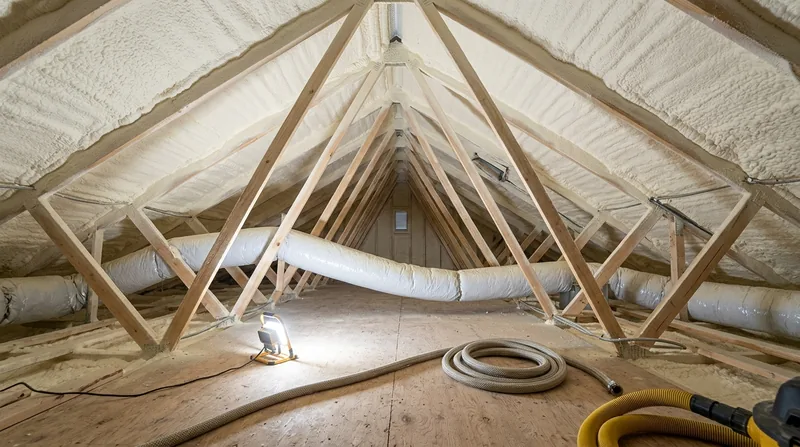




Rochester sits on Lake Ontario's south shore where the Genesee River cuts through the city in a gorge, and almost every home built before 1980 sits on a basement of Medina sandstone, limestone, or concrete block topped by an attic that bakes in July and builds ice dams under heavy lake-effect snow every winter. The wind off the water finds every gap in the envelope. When you add humid summers that flip the vapor drive, the result is an attic assembly that has to handle moisture in both directions, year-round. Attic spray foam insulation in Rochester solves this problem by sealing the roof deck, turning an unconditioned attic into conditioned space, and putting the ductwork inside the thermal envelope where it belongs. Open-cell foam on the roof decking stops the ice dam cycle, controls humidity, and costs less than closed-cell. Every estimate we write lists the R-value target, the thickness per pass, and the board footage, so you know exactly what you are paying for.
Why Attic Spray Foam Insulation Matters in Rochester and the Inner Suburbs
Rochester's climate and building stock create a perfect storm for attic failure. Homes in the 19th Ward, Beechwood, the Neighborhood of the Arts, and the South Wedge are often balloon-framed foursquares and Victorians built in the 1890s to 1920s with original fiberglass batts that have settled, compressed, or failed entirely. The inner suburbs, Greece, Irondequoit, Gates, run 1940s to 1960s capes and bungalows with knee-wall upstairs bedrooms that freeze in January because the original attic insulation has flattened. Newer colonials and two-stories in Brighton, Pittsford, Penfield, Webster, and Victor often have bonus rooms above attached garages that sit in an unvented attic where condensation forms on cold framing in winter and humidity drives mold risk in spring. Lake-effect snow piles up through long winters; the temperature swings are extreme; and every assembly has to handle both the vapor drive from inside and the moisture load from above.
- Stops ice dams by sealing the roof deck and moving the thermal boundary to the exterior of the framing.
- Controls humidity by creating an unvented, conditioned attic space that keeps ductwork and equipment at house temperature.
- Eliminates the need for soffit and ridge vents that let wind-driven rain and snow into the attic during lake-effect storms.
- Supports bonus rooms and knee-wall bedrooms by keeping them warm and dry without the freeze-thaw cycles of a vented attic.
- Protects original framing in pre-1980 stock by controlling the moisture that rots Medina sandstone and concrete block basements.
Getting the attic right is the single largest energy and durability investment a Rochester homeowner can make.
Key info: New York State building code requires a thermal barrier between the foam and the living space in attics. The fifteen-minute thermal barrier distinction, whether the foam is ignition-resistant or requires a separate gypsum layer, is governed by your local building department, not by us. We follow the code at your address and pull permits accordingly.
For more detail on how foam performs in different applications, see our guide to open-cell spray foam insulation, which is the standard choice for Rochester attics.
How We Spray Attic Foam in Rochester: Process and Precision
Every attic is different. A 1920s foursquare in the 19th Ward has a different footprint, rafter spacing, and ventilation history than a 1960s cape in Irondequoit or a 2000s colonial in Brighton. We start with a site visit to measure the attic, identify the existing insulation, check for moisture or past damage, and understand the roof assembly. We then specify the foam type, the R-value target, and the thickness per pass. Open-cell foam typically goes down in two passes of 3.5 inches each to reach R-24 to R-28, depending on your attic's current condition and your energy goals. We set up mechanical ventilation during the spray and cure process, and we specify a re-entry window of 24 to 48 hours before the space is safe for occupancy. Once the foam cures, we seal all rim and band joists, any penetrations around plumbing vents or electrical chases, and any gaps where the roof meets the walls.
- We inspect the attic, measure the square footage, and assess the existing insulation and any moisture or damage history.
- We provide a written estimate that specifies the R-value, the thickness per pass, the board footage, and the cost breakdown.
- We schedule the spray, set up mechanical ventilation, and spray the foam in controlled passes to the specified thickness.
- We allow the foam to cure for 24 to 48 hours, then remove ventilation equipment and seal any remaining penetrations.
- We provide a completion report with photos, board footage, and R-value confirmation for your records and your insurance company.
The key to a durable attic is controlling the spray, the right ratio, the right drum temperature, the right thickness per pass, and mechanical ventilation during cure. Cut corners on any of these steps and you risk poor adhesion, incomplete seal, or off-gassing that drives occupants out of the house.
Example: A 1,400-square-foot attic in Pittsford with settled fiberglass and no air sealing typically runs 1,200 to 1,400 board feet of open-cell foam to reach R-24. The job takes one day to spray and one day to cure. The ductwork stays inside the thermal envelope. The ice dam cycle stops. Heating costs drop noticeably in January and February.
If you have an attic that has never been properly sealed, or if you are dealing with a failed insulation job from a previous contractor, we also offer insulation removal and replacement as a separate service.
Attic Spray Foam Insulation Methods and Approaches
| Approach | Description | Best for |
|---|---|---|
| Open-Cell Foam on Roof Deck | Spray 6 to 7 inches of open-cell foam directly on the underside of the roof sheathing to create an unvented attic. Moisture vapor can pass through the foam, so the assembly handles humidity in both directions. Typical R-value is R-21 to R-24 per 6 inches. | Rochester attics with lake-effect snow, ice dams, and high humidity. Standard choice for homes with bonus rooms or finished attic space. |
| Closed-Cell Foam on Roof Deck | Spray 4 to 5 inches of closed-cell foam for a vapor barrier effect. The foam is denser, more rigid, and resists moisture penetration. Typical R-value is R-28 to R-30 per 5 inches. Cost is higher but durability is superior in extreme moisture conditions. | Metal buildings, barndominiums, or attics with a history of condensation or moisture intrusion. Also used when maximum R-value is needed in a thin space. |
| Blown-In Insulation Top-Up | If your attic already has sound fiberglass or cellulose and the air sealing is adequate, blown-in insulation adds R-value without the cost of spray foam. Typical addition is R-13 to R-19 depending on depth. | Attics with existing insulation that is still in place but below code. Lower cost option when the assembly is not in crisis. |
| Rim and Band Joist Foam | Spray open-cell or closed-cell foam into the rim joist cavity where the rim beam meets the foundation. This seals a major air leak path and prevents cold bridging into basement spaces and first-floor rooms. | Every Rochester basement, especially in older homes with stone or block foundations. Often paired with attic foam as part of a whole-house air sealing strategy. |
Attic Spray Foam Insulation Cost in Rochester: What to Expect
Attic spray foam insulation in Rochester typically starts at $1.50 per square foot for open-cell foam on the roof deck, depending on the attic size, the existing insulation that needs removal, and the access to the roof framing. A typical 1,200-square-foot attic with settled fiberglass runs 1,200 to 1,400 board feet of open-cell foam and costs between $1,800 and $2,100 for materials and labor. If the attic has never been properly sealed or if you are upgrading from vented to unvented, the cost can run higher because more air sealing work is required around penetrations and band joists. Closed-cell foam costs more per board foot but delivers higher R-value in the same thickness, so it may be the right choice if you are working with a tight space or if you have a history of moisture problems.
Several factors move the price up or down. A 1920s foursquare in the 19th Ward with hand-laid rafters and irregular spacing takes longer to spray than a 1960s cape with uniform 16-inch centers. An attic with vermiculite insulation (which may contain asbestos) requires removal by a licensed professional, not by us, so that cost is separate. An attic with active moisture, mold, or roof leaks requires us to fix the moisture first or we walk away, and that repair cost is also separate. An attic above an attached garage requires thicker foam and more careful air sealing, which adds to the board footage. A top-up on an attic that already has sound insulation costs less than a complete removal and replacement.
The best way to understand the cost for your specific attic is to get a written estimate with R-value, thickness, and board footage spelled out. We provide free estimates within 24 hours at (585) 565-5602, with no obligation to book. For more pricing detail and examples by attic size, see our full pricing page.
Attic Spray Foam Insulation Near Me: What to Look for When Hiring a Contractor in Rochester
Spray foam insulation is a specialized trade. The difference between a tight, durable installation and a failed one lies in the details: the spray equipment, the ratio, the drum temperature, the ventilation during cure, and the thickness per pass. When you are evaluating contractors in Rochester, Irondequoit, Brighton, Penfield, Webster, or any of the inner suburbs, look for the same markers that separate a professional from a rig-and-run crew. A written estimate should list the R-value target, the thickness per pass, and the board footage. If a contractor gives you a price without those numbers, they are not qualified. A professional contractor is fully insured and can provide proof of coverage on request. They should also explain the permitting and code requirements at your address, including any attic ventilation rules or thermal barrier requirements that apply in your city. If you have a finished attic or a bonus room, ask about the local building department's rules on unvented attics; these rules vary by city and are not our decision to make.
- Request a written estimate that specifies R-value, thickness per pass, board footage, and labor cost, not just a price per square foot.
- Verify that the contractor is fully insured and ask to see a certificate of insurance naming you as an additional insured.
- Ask how the contractor handles mechanical ventilation during cure and what re-entry window they specify before the attic is safe to occupy.
- Check references from recent attic jobs in Rochester or nearby suburbs, and ask about any odor or off-gassing issues after the spray.
- Understand your city's permit requirements by calling your local building department before you hire; Rochester, Greece, Irondequoit, and other cities have different rules.
- If you have an HOA or architectural review board, confirm that spray foam installation on the roof is allowed in your community.
- Get at least two estimates so you can compare the scope, the R-value target, and the price. A lowball estimate with no detail is a red flag.
The local independent contractor with a local address and local plates is positioned to serve you better than a national franchise or an out-of-state rig-and-run crew. We have been in business in Rochester since 2012, we know the building codes and the building stock, and we are reachable if a question comes up after the job is done. Call us at (585) 565-5602 for a free estimate and consultation.
Attic Spray Foam Insulation in Rochester: Pricing Guide
| Service | Price | Details |
|---|---|---|
| Open-Cell Attic Foam | Starting at $1.50/sq ft | Two passes of 3.5 inches each to R-24, includes air sealing of rim and penetrations |
| Closed-Cell Attic Foam | Starting at $2.25/sq ft | Higher R-value per inch, vapor barrier performance, best for attics with moisture history or tight spaces |
| Insulation Removal and Replacement | On estimate | Removal of failed fiberglass or old foam, disposal, and new spray foam installation require site inspection |
| Rim and Band Joist Foam | Starting at $8.00/linear foot | Seals foundation perimeter, prevents cold bridging, typically 40 to 100 linear feet per basement |
| Travel and Estimate | Included and Free | No mileage fees in Rochester and surrounding areas, free written estimate within 24 hours |
Indicative pricing, the exact cost depends on square footage, finish, and site access. Free personalized estimate within 24h at (585) 565-5602.


